GamePC heeft een artikel gepost waarin zij de performance van een Ultra160 SCSI RAID setup vergelijken met een IDE RAID config. De test werd uitgevoerd op een Adaptec 3200S SCSI RAID adapter met twee Quantum Altas 10K II schijven en een Abit KT7-RAID met HighPoint IDE RAID controller. Het IDE RAID systeem maakte gebruik van twee IBM 75GXP harddisks:
There's no denying that IDE/UltraATA RAID controllers have come a long way in the past six months, and even though the Ultra160 SCSI RAID setup beat it on nearly all of the tests, when price comes into the mix, the story becomes completely different. Considering the RAID chip on the KT7 board only costs about $15 more than the non-RAID version, it looks mighty temping compared to a $700+ SCSI RAID controller. Now we realize we've just scratched the surface with Ultra160 RAID, but for an everyday workstation/game rig setup, IDE RAID is a very nice solution.
[...] RAID is no longer server territory my friends, it takes about two minutes to setup, works just like a single drive setup, and gives increased I/O performance on nearly all fronts. Time to upgrade.
Thanx: Bigs en McMiGHtY voor de link!

 Here's what all you kernel hackers have dreamed of: an x86 system simulator running under GNU/Linux! The simulated system contains an x86-64 chip, RAM, disks, and VGA. You can single-step the CPU, peek at registers and memory, and lots of other fun stuff. For now, you can only run 32-bit GNU/Linux because the x86-64 kernel port isn't done. But, you can play with 64-bit mode, and you can debug those pesky 32-bit kernel bugs without having to hard-boot your hardware all the time.
 . Bedankt
  As of 5:00 pm California time on Monday, 2 October 2000, application materials seeking to operate or sponsor the new TLDs listed below were submitted to ICANN. These applications have not yet been verified to be complete or to be in proper form. (There may be missing parts of the application, omitted attachments, no or an inadequate application fee, a transmittal not in the specified form, a lack of required signatures, etc.)
 )
) 1)
1) 1)
1)
 QDR SRAM is currently being manufactured using a low-power CMOS fabrication process. At the heart of the QDR architecture are two separate double data rate (DDR) ports to allow simultaneous access to the memory storage array. Each port is dedicated, with one performing read operations while the other performs data writes. By allowing two-way access to the memory array at DDR signaling rates, a quad data rate (QDR) is established.
 :
:
 Indien u gevestigd bent in Alphen aan den Rijn, Amersfoort, Amsterdam,
Amstelveen, Apeldoorn, Arnhem, Delft, Den Haag, Diemen, Dordrecht, Haarlem,
Leiderdorp, Maassluis, Rotterdam, Utrecht, Voorburg of Zaandam kunt u,
afhankelijk van de wijk waarin u woont of uw bedrijf gevestigd is, gebruikmaken
van Mxstream.
Indien u gevestigd bent in Alphen aan den Rijn, Amersfoort, Amsterdam,
Amstelveen, Apeldoorn, Arnhem, Delft, Den Haag, Diemen, Dordrecht, Haarlem,
Leiderdorp, Maassluis, Rotterdam, Utrecht, Voorburg of Zaandam kunt u,
afhankelijk van de wijk waarin u woont of uw bedrijf gevestigd is, gebruikmaken
van Mxstream.


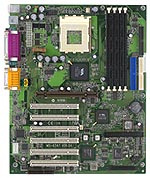 This board has just so many good things. There is tons of software to go with tons of
hardware. With SCSI, LAN, Firewire, ATA 100, RAID, and AGP pro this board has
set the benchmark for workstation class Athlon boards. You want good stuff, this
board is packed with it.
This board has just so many good things. There is tons of software to go with tons of
hardware. With SCSI, LAN, Firewire, ATA 100, RAID, and AGP pro this board has
set the benchmark for workstation class Athlon boards. You want good stuff, this
board is packed with it.
