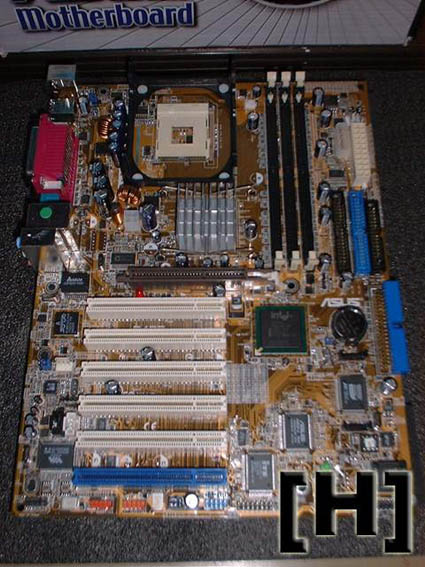
De mannen van HardOCP kregen het nieuwe Asus P4PE moederbord in handen en maakten er zo snel mogelijk een review over. De P4PE is met de i845PE-chipset één van de eerste planken die geschikt voor Intel's HyperThreading technologie, ook al kon dit niet gereviewed worden omdat er geen Pentium 4 met HT voorhanden was. Het mobo van Asus draagt naast HT verder nog een keur aan fijne features met zich mee, zoals USB 2.0, FireWire, Gigabit Ethernet en Serial ATA. Qua prestaties kwam de P4PE niet voorbij de concurrentie voor zover men kijkt naar het Pentium 4 platform. Als eenmaal de eerste HT-enabled Pentium 4's op de markt verschijnen, dan heeft Asus echter met de P4PE een hele goede troef in handen, aldus HardOCP:
Overall performance was on par with other Pentium 4 solutions although I did expect to see somewhat better scores. I believe the full potential of the P4PE goes unrealized at this time because features like Serial ATA are not able to be fully utilized along with Hyper-Threading performance going untested at this time until HT enabled processors come out of Intel. Still, DDR333 was needed on the Intel chipset platform and we did not think they were going to work miracles with it...as we are sure they are waiting for dual channel DDR to do that.
The board was extremely solid, performed extremely well and I have no problems with recommending it for you if it suits your needs. Interestingly enough, Kyle was testing another Asus P4PE while I was working on mine. You can see more P4PE benchmarks at 2.8GHz over in his 2800+ article. I think he snuck those in there before the i845PE launch hoping no one would notice.
What I do see here today, I liked. The P4PE will definitely have to make a return to the HardOCP test bench when we see our first Hyper-Threading CPU’s roll out and give this board a chance to really show its stuff. It only stands to reason that the ability to “multi-task”, even if not fully utilized by the application and OS, will definitely show a benefit in the benchmarks. So, if you're a man who likes to plan for the future, the P4PE is definitely a board you'll want in your system…I’m betting on it.
:strip_exif()/i/1034540782.jpg?f=thumbmedium)

 4G mobile communications system offering high-speed transmission of large-capacity data with wide coverage requires a bandwidth of approximately 100 MHz. When using a channel with such a broad bandwidth, transmission quality required can be impaired by a large number of multipaths, that is, the occurrence of secondary signals reflected off buildings, mountains and other surrounding objects. DoCoMo's experimental 4G mobile communications system employs variable spreading factor (VSF) and orthogonal frequency code division multiplexing (OFCDM) technologies which is developed by DoCoMo to mitigate the impact of severe multipath interference, and to allow flexible and fast packet transmission in compliance with area and other communications conditions, thereby achieving a broad-bandwidth, large-capacity wireless system.
:strip_exif()/i/1051861590.jpg?f=fpa)
:strip_exif()/i/1043459009.jpg?f=thumbmedium)
 Volgens analist Gillett van Forrester Research is deze stap niet alleen een slimme zet in verband met de licentieperikelen van Microsoft, maar ook omdat Apple door deze actie direct bruikbaar geld in handen krijgt, terwijl men altijd nog kan besluiten om in de komende drie jaar slechts enkele upgrades uit te brengen. Bovendien speelt volgens Gillett mee dat door deze langdurige contracten overstappen naar concurrenten bemoeilijkt wordt. Op dit moment bezit Apple een zeer klein aandeel in de serversoftware-markt.
 Optische dataopslag wordt als oplossing gezien voor de problemen die dit soort massale datadoorvoer zal geven. Hiertoe heeft Toshiba op Ceatec een 15 gigabyte singe-layer disk gedemonstreerd, die via een 405 nanometer blauwe laser snelheden tot 36 megabit per seconde haalt. Ook Philips deed een duit in het zakje, met een rewritable optische schijf ten grootte van een munt, waarop 1 gigabyte aan data kwijt kan. Pioneer liet van zich horen met een bijna transparante read-only schijf met 25 gigabyte aan capaciteit. De draadloze technologiëen die het e-Japan netwerk mogelijk moeten maken zouden deels op de IEEE 802.11e-standaard gebaseerd moeten worden.
 "I have stood at the RSA booth in conferences, with my phone paging for other devices, and watched other people's devices show up," said Magnus Nystrom, technical director of RSA Security. Many devices simply allowed access without demanding a "pairing" code, said Nystrom, and would have allowed him to examine the personal data of passers-by, or even to make calls with their phones.
 .
. EPoX heeft twee nieuwe moederborden aangekondigd, zo