USA Today schrijft dat IBM bezig is met de ontwikkeling van cellulaire computers. Dit houdt in dat een computer niet langer werkt met één snelle CPU, maar met een cluster van een groot aantal kleine processors. Deze zogenaamde 'cells' worden in aantallen van 32 tot 36 op een chip geplaatst. Het grootste probleem waar de ontwerpers mee geconfronteerd worden is de complexiteit van de besturingssoftware. De software moet bepalen welk geheugen en welke resources aan de cellen toegewezen kan worden:
These computers won't operate like today's, where a central processor interacts with surrounding memory and communications circuitry. Instead, they will run on chips containing ''cells,'' where tiny processors are integrated directly with memory and communications circuits. IBM says a rough equivalent is putting the power of 32 desktop computers on a dime-sized chip.[...] Currently, IBM envisions 32 to 36 cells on a single chip. Each cell would have a 1-gigahertz processor — about the speed of today's fastest desktop computers. And each cell would have networking circuitry capable of moving data extremely fast. The chip would contain 500 megabytes to 1 gigabyte of memory allocated among the cells according to need.
''The hard part is the software,'' said Dean. Software will determine how to allocate memory and other resources to each cell. [break] Als toepassing van de cellulaire computers ziet IBM bijvoorbeeld genetisch onderzoek of het serversysteem achter een grote search engine. Bij dergelijke toepassingen kan een cellulaire computer de onderlinge taken over de cellen verdelen, waardoor hogere prestaties behaald kunnen worden dan bij traditionele computers die gebouwd zijn rond een CPU. IBM werkt aan een prototype met een theoretische performance van 1 Petaflop. Ter vergelijking: een PIII-500 haalt maximaal 2Gigaflops: [/break] When today's computers are asked to find the name of a book's author, for example, they command a database to search all its memory for the answer. A cellular computer would divide the work, commanding all cells at the same time to search for the answer. Only the cell with the answer will respond; all others will find nothing and stop searching.
[...] One vehicle for IBM's cellular research is a $100 million project, dubbed ''Blue Gene,'' to build a supercomputer for genetic research that is capable of 1 quadrillion operations per second. This is needed to show in three dimensions how human proteins fold, a key to selecting drugs to attack genetic diseases.
Thanks iMoD voor het insturen van de tip.
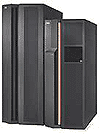 The eServer pSeries 680, formerly known as the S85 Turbo, comes with
new processors that improve performance 60 percent to 65 percent from the S80 predecessor, said
Mike Kerr, vice president of IBM's line of Unix servers.
The eServer pSeries 680, formerly known as the S85 Turbo, comes with
new processors that improve performance 60 percent to 65 percent from the S80 predecessor, said
Mike Kerr, vice president of IBM's line of Unix servers.

/i/1259849339.png?f=fpa)
 :
:
 SAN JOSE, Calif., Oct. 16 /PRNewswire/ -- 3dfx Interactive(R) Inc. (Nasdaq: TDFX) announced today that it has received favorable court rulings concerning the scope of the patents it has asserted against nVIDIA Corporation (Nasdaq: NVDA) in a patent infringement lawsuit originally filed by 3dfx on September 21, 1998. The company also announced that as a result of these favorable rulings, it plans to file for summary adjudication of infringement.

 We burnt over ten CDs using the BURN Proof option while doing other tasks in the background which ranged from transferring files through a network, copying files from the DVD-ROM, surfing the net and listening to MP3 files. The result: Not a single coaster!
 Rendition's Verite 4400 exists in silicon, and it has a whopping 125Million transistors... That is nearly 4 times larger than RADEON and two times larger than the NV20A, the XBox GPU...
 .
. 703)
703) 1)
1) )
)
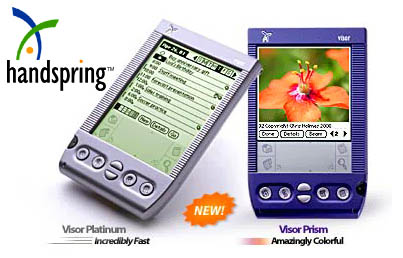
 . Geïnteresseerden kunnen de Visor Prism en Visor Platinum voor een prijs van respectievelijk 575 en 355 euro oppikken vanaf
  De Visor Prism
 Cary Sterman – vice president van de RIAA – vergelijkt het komende systeem met streepjescodes die op cd's staan. Als er een cd in een winkel wordt gekocht, worden automatisch de auteursrechten afgedragen. Iets dergelijks moet ook gaan gebeuren met gedownloade muziek.
 In het tweede kwartaal van 2001 worden nieuwe mobile PIII's gereleased die zijn gebaseerd op de Coppermine-T core. De Cu-T is een 0,13micron die-shrink van de huidige Coppermine en zal tevens de busspeed van de mobile PIII naar 133MHz opkrikken. In hetzelfde kwartaal worden de eerste mobiele Tualatin-Pentium III's verwacht. Deze processors zullen kloksnelheden van 1,13 en 1,26GHz bereiken op een 133MHz bus.
 Al het goede komt in drievoud, want ook bij TweakTown kunnen we een