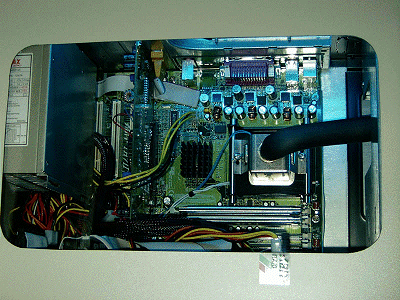
Op OcPrices is een verslag te vinden van een klein evenement dat is gehouden door Abit in Stockholm. Naast de nodige moederbord-plannen kwamen er ook nog een hoop interessante nieuwe dingen naar boven drijven voor overklokkers. Een deel van de nieuwigheidjes is al terug te vinden op één van de nieuwste borden van het bedrijf, de TH7II-RAID. RAID is overigens - zoals we al lang gemerkt hadden - de standaard geworden bij Abit. Naast de overklok-strips, het extra hoge CPU voltage en de diagnostische LED display is deze namelijk ook voorzien van AGP/PCI fix. Dat wil zeggen dat de FSB niet langer is gekoppeld met een vaste divider aan andere bussen, maar dat deze door middel van SoftMenu III altijd constant kan worden gehouden. Naast dit soort innovaties voor moederborden werkt men ook aan een nieuwe videokaart die dankzij een 30% betere heatsink beter over te klokken moet zijn, de GeForce3 IVO. In samenwerking met Asetek demonstreerde het bedrijf een 2520MHz Pentium 4 (140x18) die slechts 10 tot 12 graden celcius werd:
The reason for Asetek being there that day (other than presenting their own line of products) was that they were using the TH7II-Raid in their system. Due to the AGP/PCI fix mentioned above, you can overclock (or 'thermically accellerate' as they call it) your CPU and not overclock you AGP or PCI devices at all. As they are now targeting CAD and other companies who are very dependant on CPU power, this is of course amazingly important as they are only interested in totally stable systems.
Thanks wederom JAMF!
:strip_exif()/i/1000147245.jpg?f=thumbmedium)

 AMD therefore may be able to produce a Hammer chip that can deliver three times the performance of Athlon technology - something that CEO Jerry Hammers claimed was possible as long ago as spring last year.
 .
. Apart from a great overclocking potential, these boards feature as well a UATA/100 IDE RAID which will help you overclock a disc subsystem if you have two hard discs. The Abit's board can boast of a very powerful overclocking tool - POST-card, while the Soltek's one can be proud of a solid RAID chip from Promise and of onboard sound based on the Creative chip. Well, whichever you may like, both are very good.

 So claim sources said to be close to Apple, at any rate. The new CPU will be offered at 800MHz, 1GHz, 1.2GHz, 1.4GHz and 1.6GHz, and while the first two are nominally aimed at the embedded space - the others are aimed straight at the desktop, we hear - we can see Apple using them as to transition over from the top end G4, the PowerPC 7450.