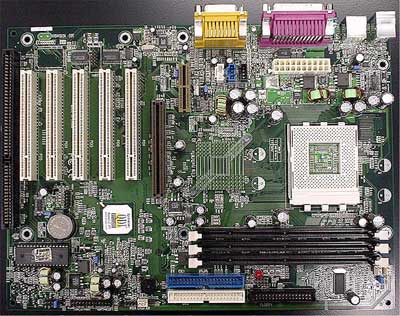
Hete Hardware heeft een review gebakken van de QDI KinetiZ 7T mamaplank. Zoals je misschien nog kan herinneren van Computex 2000, is dit de eerste plank waarvan bekend was dat ie de mogelijkheid ging krijgen om de multiplier te veranderen van ungelockte Durons en Thunderbirds. In het lijstje met specs staat deze optie er wonderbaarlijk genoeg nog steeds tussen, en zelfs op het moederbord zijn een paar dipswitches te vinden waarmee om de multiplier te tweaken. Jammer genoeg blijft het daar ook bij, het spelen met de dipswitches resulteerde bij de reviewer in alles behalve in een werkende PC.
Hierbij blijft het niet bij, de layout van de plank lijkt op het eerste gezicht wel redelijk te zijn maar het blijkt dat je met wat pech niet je full-length PCI kaarten kwijt kan en ook zit de aansluiting voor de ATX voeding op de verkeerde plaats. Daarnaast heeft de plank geen mogelijkheid het voltage aan te passen, werkte de eerste IDE poort niet en hetzelfde liedje zong de +33 geheugen setting.
Ondanks deze negatieve punten krijgt de plank toch nog een voldoende van de reviewer (Iets wat ik niet echt begrijp, maarja wie ben ik...), dit omdat de plank redelijk goed presteerde en daarnaast ook nog stabiel was:
OK, so that's not really a big deal. I guess no one at QDI's ever had the pleasure of using an EPoX board, with it's single jumper multiplier adjuster. Or maybe they've never had the blissful experience of toying with Abit's SoftMenu™ III. But hey, they did give us the ability to change the multiplier, so I should stop my girlish whining, right? Of course I should... But alas, I cannot. You see, this feature didn't work! So, sorry kids, I tried two different unlocked Durons (650 and 700), and no amount of multiplier changing, up or down, resulted in anything resembling a computer booting up, let alone a post screen. Not that you'd be able to do much multiplier changing, in the first place. It seems QDI conveniently forgot to add the ability to change the voltage. I guess they don't do too much overclockin' over there. Probably a government thing. So, I'm sorry to tell you this, but your not gonna crank that 600MHz Duron up to 1GHz, on the KinetiZ 7T. All though, it is good to see that the QDI engineers have a bit of a sense of humor, as they gave the 7T the ability to crank the FSB up to 166MHz (Ha! Good luck there tough guy...).
[...] Anyway, regardless of all the KinetiZ 7T's short comings, It still managed to to be a stable, and decent performer. And those were the only reasons I didn't give it our lowest rating. The QDI KinetiZ 7T has a less then perfect layout, has features that do not work (multiplier changer), a lackluster BIOS (no voltage adjustment) and basically didn't run correctly (IDE port 1). Because of these "issues", I'm going give the QDI KinetiZ 7T a Hot Hardware Rating of..... 6
 |


 0) 3.269.810
  1) 350.095
  1) 310.805
 InnoVision heeft vandaag een
  Hong Kong 4th Sept, 2000 --- InnoVISION Multimedia is excited to announce the first in a series of 3D graphic accelerator based on the innovative architecture KYRO 3D processor from STMicroelectronics, the Inno3D KYRO 2000. This is the first full-featured PC Graphics and Video Accelerator based on Imagination Technologies' PowerVR™ Series3 technology. The Inno3D KYRO 2000 combines breathtaking 3D graphics image quality, stunning 3D graphics performance and super crisp 2D Graphics. This Accelerator also delivers studio quality Video Playback and DVD decode support. It would be a perfect match with system boards like the Intel 815 or equivalent, which will provide the user with a well-balanced and high-performance solution for both corporate and consumer platforms.

 Ook is er een pagina waarmee je "geholpen wordt" de juiste keuze te maken qua ISP. Helaas is het stukje hierover erg kort (7 regels tekst) en niet echt duidelijk.
 When I started the research for my Wilma articles for RWT my natural suspicion
of Intel led me to suspect that it would be a cheap clock rate play, an
upscale version of Centaur's strategy to hoodwink the masses with empty MHz.
But the more Wilma patents I analyzed and the more pieces of the puzzle I put
together the more impressed I was with it. It is the most innovative new
processor core I have seen since the Alpha EV6.
When I started the research for my Wilma articles for RWT my natural suspicion
of Intel led me to suspect that it would be a cheap clock rate play, an
upscale version of Centaur's strategy to hoodwink the masses with empty MHz.
But the more Wilma patents I analyzed and the more pieces of the puzzle I put
together the more impressed I was with it. It is the most innovative new
processor core I have seen since the Alpha EV6.