Enkele aandeelhouders hebben een proces tegen ATi aangespannen. ATi heeft in de eerste twee kwartalen van boekjaar 2000 de financiele cijfers te positief uitgelegd. Bij diverse gelegenheden heeft ATi aangegeven dat ze een groei verwachtte van 25%, dat ze meer dan 5 miljoen Rage Mobility chips verkocht hadden en dat ze een overeenkomst hadden bereikt met Sony. Zodoende heeft ATi de aandelen kunstmatig hoog gehouden en extra inkomsten gegenereerd. Op 24 mei 2000 moest ATi echter een winstwaarschuwing afgeven voor kwartaal 3 waardoor de marktwaarde flink daalde. De aandeelhouders vinden dat ze teveel voor de aandelen hebben betaald destijds en eisen een schadevergoeding voor de mensen die aandelen hebben gekocht tussen 13 januari en 24 mei 2000:
The suit against ATI alleges that shareholder Susan Kaplowitz of New Jersey and other investors paid too much for ATI stock during a five-month period last year when the shares rose but then fell precipitously on a profit warning.During the first two quarters in fiscal 2000, ATI painted an "unrealistically positive" picture of its business by telling investors in conference calls and in news releases that it expected to reach sales growth of 25 per cent in 2000, that more than five million Rage Mobility chips had been shipped and that it had secured a supply agreement with Sony Electronics Inc., the complaint alleges.
The lawsuit alleges that by late 1999 and early 2000, ATI was experiencing declining demand for its graphics cards products and lowered prices to stimulate sales when two competitors S3 Inc. and Neomagic flooded the market with cheaper products. On May 24, 2000, ATI lost $2.2-billion (Cdn) in market value after warning of unexpected losses for its third quarter. [break]ATi reageerde kort maar krachtig:[/break]"We're surprised by the claim, we'll defend the claim vigorously."

 Intel has confirmed it will release a 2GHz Pentium 4 next quarter. Company officials, speaking at their annual shareholders meeting, hinted that the schedule for the part's release had been accelerated, according to EBN. Information leaked from the company earlier this month suggests the 0.18 micron 2GHz P4 will cost $562 when it's introduced.
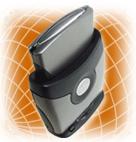 Roy, Utah-based Iomega, known for its Zip and Jaz drives and disks, said that it was now shipping its Peerless system, a standalone, peripheral drive that comes in 10 gigabyte and 20 gigabyte capacities, greater than that of DVD- or CD-writeable disks. The two-piece system includes a disk roughly the size of a handheld computer or PDA, which slips into a vertical docking station. The drive will sell for about $250 while the disks will retail at $160 for 10 gigabytes and $200 for 20 gigabytes. Combined packages will be discounted, Iomega said.

 It is possible to gain access to cordless devices. The keystrokes may be sniffed in plain, unscrambled text. It is possible for the victim AND the attacker to read the keystrokes without the victim to notice the attack, since it's a (mostly, see below) non-intrusive 'trojanizing', to say so ;-).
 Transmeta designed the Crusoe chip to use much less power than the conventional mobile processors sold by Intel and AMD, but both have recently started selling their own, lower-power offerings. What distinguishes the Crusoe chip from Intel's and AMD's is that it uses software rather than designs in the actual chip to gain the low-power, high-performance characteristics that laptop users typically want. Lower power consumption translates to longer battery life.
 :
: An expert technical panel set up by the Italian court last week had upheld the validity of the Rambus patents, which the Los Altos, Calif., company claimed Micron had infringed. However, the judge Thursday overruled that finding and determined that Micron had not violated the patents.
 "The 64-bit Windows platform is the best choice for customers who want to combine powerful, 64-bit computing with great price/performance and manageability, unmatched scalability, and broad hardware and software support," said Brian Valentine, senior vice president of Microsoft's Windows Division. "Microsoft is fully committed to the Itanium program and is working closely with Intel, our customers, and industry partners to ensure that Windows provides unmatched support for 64-bit computing and that the best of the industry's hardware and software is available when we launch."