 Bij SysOpt staat een artikel over de controverse rond VIA's DDR-compatible chipset P4X266, voor Intel's Pentium 4 processor. Een DDR-chipset voor de P4 lijkt prijstechnisch een zeer interessant alternatief te kunnen bieden, voor de geavanceerde maar duurdere RDRAM systemen, ondanks de prijsdalingen van P4's, P4 mobo's en RIMM's. Officieel komt Intel binnenkort met de i845 Brookdale SDRAM chipset. Dat zal weliswaar goedkopere P4 systemen mogelijk maken, iets waar OEM's behoefte aan hebben, maar de prestaties van de combinatie PC133 SDRAM met een 400MHz bus en de op RAMBUS ontworpen P4, zullen er naar verwachting flink onder lijden. Hoewel DDR geheugen in dit specifieke geval niet de perfecte vervanger van RAMBUS geheugen zal zijn, kan DDR, o.a. vanwege de grotere bandbreedte, wel beter presteren dan SDRAM en wellicht soms zelfs in de buurt komen van RDRAM. Tel daarbij de scherpe prijsstelling van DDR geheugenreepjes en het is duidelijk dat dit marktpotentieel heeft. Intel's Brookdale chipset blijkt ook DDR geheugen te ondersteunen, maar officieel is Intel tot 2002 gebonden aan RAMBUS voor de P4. VIA zou dus een behoorlijke hap van de P4 markt kunnen pakken, zelfs al zou Intel hen nu een licentie verlenen en zelf ook met een Brookdale-DDR chipset komen.
 Het is dus niet zo vreemd dat Intel VIA (nog) geen licentie geeft, iets wat volgens Intel noodzakelijk is voordat VIA met een chipset de markt op mag komen, die op de gepatenteerde bus van de P4 aansluit. VIA op haar beurt, claimt wel degelijk het recht te hebben een dergelijke chipset op de markt te brengen, omdat zij S3 Technologies hebben overgenomen. S3 is een video-chipset fabrikant die een licentie heeft om P4's architectuur know-how toe te passen op haar producten. Tot nu toe was het onduidelijk hoe VIA S3's licentie precies zou kunnen gebruiken voor haar nieuwe P4X266 chipset, die onlangs werd gepresenteerd en gedemonstreerd op Computex 2001. Ookal werden nog geen officiële release-dates bekendgemaakt, wel was duidelijk dat men klaar was om op korte termijn het product in volumes op de markt te brengen. Voorlopige benchmarks t.o.v. Intel's i850 chipset klonken veelbelovend (cijfers die overigens door Intel werden afgedaan als "bogus"), zeker als je bedenkt dat dit een goedkopere oplossing zou moeten worden.
Maar inmiddels is er informatie verkregen over de wijze waarop VIA Intel's licenties denkt te omzeilen: Men integreert in de Northbridge van alle P4M266 chipsets een S3 graphics controller. Omdat de controller van S3 legaal gebruik kan maken van de P4 bus, neemt men aan dat ook voor alle in de die daaraan verbonden componenten dit gebruik geldig is:
 While the integrated graphics DDR chipset officially known as the P4M266 will be offering a solution similar to Intel's current i815 approach. The S3 graphics chipset will be integrated into all P4M266 Northbridge controllers leaving the actual motherboard manufacturer to decide whether to implement this option within the final product. Seems VIA is learning and adapting to its competitors' technology through both design ingenuity and product imitation.
The real question is: will any of this actually affect Intel's market presence or product sales rates? This is speculative at best, as increased acceptance of a VIA DDR chipset would allow for additional Pentium IV processor sales, thus offering a potential offset to reduced chipset sales. A noted concern in this supposition is just how large is Intel's profit margins for either of these products. In terms of raw processor sales, AMD has taken a significant 30% overall market share. Similarly VIA and SIS are holding a large portion of chipset sales within both the retail and OEM segments respectively. This imposing degree of competition is also a driving force in Intel's latest round of price cuts, so it is unknown just how far Intel is willing to sacrifice higher profits for improved product visibility. Either way, DDR memory for the Pentium IV will be a reality in the near future. It is just a question of who will be the first, VIA or Intel.

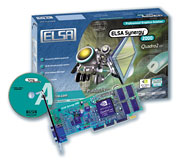 Regarding this test, through observed the test scores points the situation, the result already extremely is actually clear. Synergy 2000 leads in all tests, no matter is datum test software or in the application test, in the major part test its performance all compared second outdoes above one time. Synergy 2000 promotes is extremely prompt, it greatly promoted the basic level specialized graph product performance standard, caused the basic level product performance to be allowed with above the application software performance and the function promotion. But the ELSA other together basic level reveals card Synergy II, although its speed and Syergy 2000 compares has a bigger disparity, but the performance is generally speaking alright, moreover has the very good compatibility, not discovers any compatible aspect in this test the question.