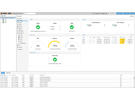
 Proxmox VE is een opensourceplatform voor virtualisatie gebaseerd op KVM en LXC-containers. Het kan via een webinterface worden beheerd en daarnaast zijn een commandline en een rest-api beschikbaar. Voor meer informatie verwijzen we naar deze pagina en verschillende videotutorials kunnen op deze pagina worden bekeken. Het geheel wordt onder de APGL uitgegeven. Versie 9.3 is uitgebracht en de belangrijkste verbeteringen die daarin zijn aangebracht zijn hieronder voor je op een rijtje gezet:
Centralized SAN visibility, volume-chain snapshots, and custom storage plugin supportTo eliminate manual, node-by-node configuration across multi-node clusters, Proxmox VE 9.3 introduces centralized multipath management alongside a new cluster-wide SAN view under Datacenter > SAN that displays LUN path state across all nodes in real time, complemented by a node-level SAN panel listing local LUNs, paths, usage, and active iSCSI sessions. A guided setup workflow configures multipath across cluster nodes and provisions shared LVM storage on iSCSI, Fibre Channel, and NVMe over Fabrics LUNs directly from the web interface.
In addition, Proxmox VE 9.3 now offers full production support for snapshots as volume chains on thick-provisioned LVM, including shared LVM storage on iSCSI and Fibre Channel SANs. Administrators can enable this capability directly in the advanced storage settings via the “Allow Snapshots as Volume-Chain” option.
Third-party storage plugins can also now be added and edited directly in the web interface and are listed in the "Add" menu under Datacenter > Storage. Proxmox VE dynamically generates configuration forms from each plugin's property schema – supporting existing plugins regardless of their storage API version – while masking sensitive credentials such as passwords and keys.
Unique guest identities & optimized cluster maintenanceProxmox VE 9.3 assigns each guest a unique identity that stays the same across migrations, backups, and restores – even if a guest receives a new VMID or is restored to another cluster. This enables backup software and external management tools to reliably recognize the same guest across its lifecycle, which is useful for the partner and tooling ecosystem around Proxmox VE.
Ongoing cluster administration, routine maintenance, and incident troubleshooting are further streamlined in the web interface and installer:Software-Defined Networking enhancements
- HA maintenance mode of nodes in the GUI: Administrators can enable or disable High Availability (HA) maintenance mode for individual nodes directly from the “Node Maintenance” menu in the HA status panel or via a new API endpoint, simplifying planned host maintenance without using the “ha-manager” command line tool.
- Structured log and update views: Proxmox VE 9.3 introduces a color-coded, filterable System Log, a new API Access Log, and an APT History view listing past package transactions and changelogs.
- Nested match rules for notification matchers: Notification routing logic that previously had to be split across several matchers now fits into one. A new tree-based rule editor with drag-and-drop support allows administrators to combine, invert, and nest alert routing conditions – including weekday and time-range selectors.
- Management bond & VLAN setup in the installer: The installer (GUI, TUI, and automated) can set up the management network on a bond, a VLAN, or both.
Proxmox VE 9.3 expands its integrated Software-Defined Networking (SDN) stack with improved network isolation for Simple zones, which can now use a dedicated Virtual Routing and Forwarding (VRF) instance to isolate their routing table with custom static routes. In addition, WireGuard fabrics now report the status of their interfaces and peers directly in the management interface, giving administrators clear visibility into tunnel health.
Updated technology stack, Ceph Umbrella preview, and Proxmox Offline Mirror 0.8Proxmox Virtual Environment 9.3 is based on Debian 13.8 “Trixie” shipping with Linux Kernel 7.0 as the stable default for broad hardware compatibility and a new, opt-in Linux Kernel 7.3 based directly on the upstream stable branch from kernel.org. Version 9.3 also includes the latest versions of QEMU 11.1, LXC 7.0, and ZFS 2.4. For hyperconverged storage, it provides Ceph Tentacle 20.2 as stable version alongside Ceph Umbrella 21.2 as a technology preview, which brings an optimized erasure-coding I/O path, hardened CephX authentication with a new default cipher and online key rotation for daemons, and an optional backup mechanism for the monitor database. For air-gapped environments, the updated Proxmox Offline Mirror 0.8 introduces automated snapshot pruning, “last” snapshot symlinks, and parallelized, lower-memory package synchronization.