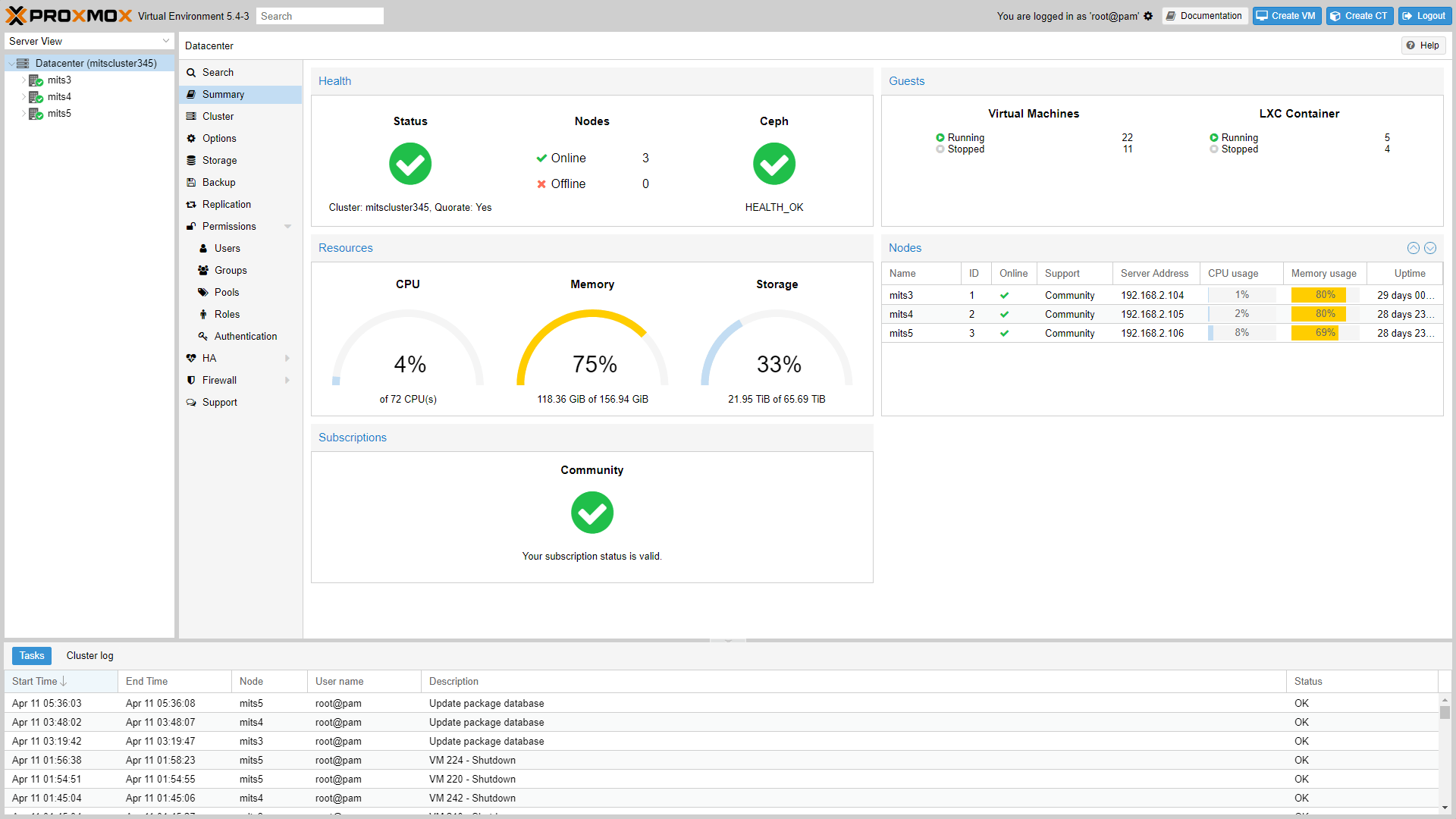
 Proxmox VE is een opensourceplatform voor virtualisatie gebaseerd op KVM en LXC-containers. Het kan via een webinterface worden beheerd en daarnaast zijn een commandline en een rest-api beschikbaar. Voor meer informatie verwijzen we naar deze pagina en verschillende videotutorials kunnen op deze pagina worden bekeken. Het geheel wordt onder de APGL uitgegeven. Versie 9.2 is uitgebracht en de belangrijkste verbeteringen die daarin zijn aangebracht zijn hieronder voor je op een rijtje gezet:
Dynamic Load BalancerA highlight of version 9.2 is the introduction of the Dynamic Load Balancer, which utilizes an intelligent decision-making framework to optimize guest placement for maximum cluster balance and reliability. Operating in a new dynamic mode, the cluster resource scheduler (CRS) incorporates real-time node and guest resource utilization into every placement decision. The integrated load balancer can automatically migrate guests managed by the High Availability (HA) stack to reduce the imbalance across the cluster nodes while strictly respecting all user-defined HA rules. Administrators maintain granular control through configurable options that define the behavior and sensitivity of the load Balancer through various parameters, providing organizations with superior oversight of resource utilization in highly available environments.
Expanded software-defined networking (SDN)This release significantly improves its SDN stack to support modern network architectures.
- New Fabric Protocols: Native support for WireGuard and BGP has been integrated into the SDN stack.
- BGP/EVPN filtering: Support for route maps and prefix lists allows for fine-grained control over route redistribution.
Further additions include route redistribution for OSPF fabrics, additional options for configuring EVPN controllers, and IPv6 underlay support for EVPN.
Custom CPU model managementTo provide greater flexibility for specialized workloads, Proxmox VE 9.2 introduces a dedicated management interface for custom CPU models. Administrators can now create, edit, and remove custom CPU profiles directly in the web interface under the “Datacenter” section. This makes it easier to tailor the virtual CPU features exposed to VMs, ensuring optimal workload performance. Additionally, the integrated CPU flags selector provides instant visibility into supported flags across all cluster nodes, helping administrators identify potential cluster-wide compatibility issues during the configuration phase.
Confident maintenance with HA Arm/DisarmAddressing common administrative challenges during maintenance windows, Proxmox VE 9.2 introduces the ability to "disarm" and "arm" the HA Manager cluster-wide. Administrators can temporarily suspend the HA stack during planned cluster maintenance to prevent unwanted actions, such as fencing nodes. HA resource states are preserved during these disarm and arm cycles, ensuring HA resources return to their previous state and node placement automatically once maintenance is completed.
Updated technology stackProxmox Virtual Environment 9.2 is based on Debian 13.5 "Trixie" and features Linux kernel 7.0 as the new stable default. Along with the latest versions of QEMU 11.0, LXC 7.0, and ZFS 2.4, this release offers a high-performance open-source architecture for modern infrastructure.
As a complete data center ecosystem engineered for high-density virtualization and disaster recovery, version 9.2 provides businesses with a seamless management environment for compute, storage, and backup. This includes updated support for the storage layer, with Ceph Tentacle 20.2. now available as a stable option alongside Ceph Squid 19.2.
Resources:
- Forum Announcement: https://forum.proxmox.com/
- Video tutorial: What’s new in Proxmox VE 9.2
- Roadmap: For published and upcoming features, see the Release Notes & Roadmap

:strip_exif()/i/2003599062.png?f=thumbmedium)
/u/203240/crop68499ca5e485a_cropped.png?f=community)
:strip_icc():strip_exif()/u/1434986/crop649350276f23c_cropped.jpg?f=community)

:strip_icc():strip_exif()/u/506130/keitjes.jpg?f=community)


:strip_exif()/u/38542/Scrat1ani.gif?f=community)
:strip_exif()/u/8422/waarschuwing.gif?f=community)
/u/212652/discopl0.png?f=community)
:strip_icc():strip_exif()/u/1765012/crop625957bc2a74b_cropped.jpg?f=community)
:strip_icc():strip_exif()/u/360263/crop57d4784c7dec4_cropped.jpeg?f=community)
 Het web interface is ook super fijn, gebruik putty vrijwel niet meer omdat alles via de shell kan
:strip_exif()/u/322645/crop5a9092a3b809f_cropped.gif?f=community)