 DietPi is een lichtgewicht besturingssysteem voor zogenaamde singleboardcomputers. Het is op Debian gebaseerd en geoptimaliseerd om maximale prestaties uit de kleine computers te halen. DietPi heeft daarnaast ook een groot aantal ready-to-run applicaties die kunnen worden geïnstalleerd. Hoewel de naam anders doet vermoeden is het niet alleen geschikt voor Raspberry Pi's, maar ook prima te gebruiken op hardware van bijvoorbeeld Odroid, Orange Rock en Pine. Versie 10.7 is uitgekomen en hier zijn de volgende veranderingen en verbeteringen in aangebracht:
New imagesNew software
- Containers with network | We added support for containers with virtual network, providing images with network stack and SSH server pre-installed, which configure the network on first boot based on dietpi.txt choices, using DHCP on any first detected veth or VLAN interface by default. These work all e.g. for LXC containers. #8238
- ARMv8 VMs | We added support for ARM VMs, and will host a full set of images and virtualizer appliances. We could not test all of them yet. Let us know if you face any issues, or importing an appliance (OVA/VMX/UTM) fails. We might need to adjust the VM configurations a bit.
- LubanCat 4 | Support for this EmbedFire SBC with Rockchip RK3588S SoC has been added to DietPi, based on mainline Linux and U-Boot. #8258
New tools
- HomeBox | This self-hosted home inventory and organisation system has been added to our software catalogue with ID 219. #8240
- Scrypted | This high performance video integration and automation platform has been added to our software catalogue with ID 220. #8277
Enhancements
- dietpi-network | The DietPi network configuration has gone through a rework. A new tool
dietpi-networkallows to configure multiple Ethernet(-like) and WiFi interfaces. This allows to e.g. configure one interface with gateway for Internet access, and another one with static IP and without gateway for LAN access. This works independently of the interface name, i.e. it does not need to beeth[0-9]orwlan[0-9], but the type is detected in other ways, which adds support for systemd's "predictable interface names", as well as virtual interfaces as provided in container guests. A CLI has been added to add, remove, or adjust individual interfaces. Configurations are stored in per-interface/etc/network/interfaces.d/<name>.confdrop-in config files, and also automatically migrated from the previously used/etc/network/interfaceswhen applying changes. These changes are a basis to allow configuring more complex network setups, like bridges, NAT, and e.g. more flexible WiFi-to-WiFi hotspots.Bug fixes
- Allwinner SBCs | USB DVB device drivers have been re-added to the kernel packages. They were lost for Allwinner boards between Linux 6.12 and 6.18. Now they are added to all kernel builds via post-config hook, i.e. independent of the used defconfig. #8218
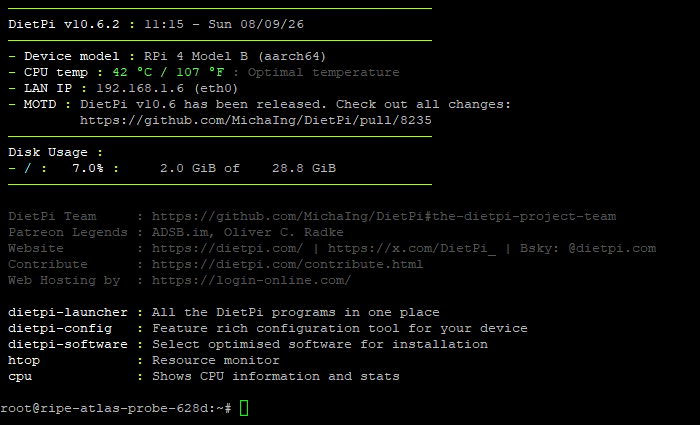
- DietPi-Banner | The Fail2Ban status now also counts bans for whole subnets in CIDR notation, which can be applied manually via
fail2ban-client. The banner message now accordingly refers to "ban(s)" instead of "banned IP(s)".- dietpi-timesync |
/boot/dietpi/func/run_ntpdhas been renamed to/boot/dietpi/func/dietpi-timesync, for consistency, and since it does not make use of thenptdtools anymore since years. When time is synced, it does now restartsystemd-timesyncd.service, to force a fresh connection attempt to the time servers in any case. Especially when the service starts during boot, it has been observed to give up for a while, if network connectivity has not been fully established yet./boot/dietpi/func/dietpi-timesyncis called at a later boot stage, and in the context of thedietpi-updatecheck preceded by a general network connectivity check, so thatsystemd-timesyncdis more likely able to connect to time servers immediately. This change may hence speed up, or even avoid the timeout abortion of the initial time sync at boot, and following DietPi and APT update checks, if enabled.- dietpi-software | Chromium: The low-end device mode flag and some other legacy flags, aiming to maximise Chromium performance at the cost of visual quality, have been removed from our config /etc/chromium.d/dietpi. These had some value at Raspberry Pi 1 times, but since some years, Chromium cannot be executed on ARMv6 SBCs anyway. For Chromium to be started as root, e.g. in some kind of minimal kiosk setup, the
--no-sandboxflag is needed, and the--test-typeflag hides a warning that skipping the sandbox is not recommended for security reasons. This is now applied only conditionally, if Chromium is really started as root user, otherwise sandboxing is used. Note that we generally do not recommend to start desktop sessions and GUI applications as root on a regular basis, and some, like Chromium and Mate, will throw respective warnings. Hence this is mainly aimed for direct Chromium starts from Linux console, where additional permissions are needed in any case, with trusted websites, like a fixed page in kiosk mode. #25394
- Raspberry Pi | Resolved an issue where
dtparamentries inconfig.txtwere ineffective, if DRM/KMS was enabled. Anydtparamentry sorted after anydtoverlayentry, is gets applied to the overlay, rather than the base device tree, that way becoming ineffective, or change/break the overlay. This particularly started to cause issues since DietPi v10.5, when we addeddtoverlay=vc4-kms-v3das commented line into the display section of our defaultconfig.txt, above alldtparamlines. As fast as KMS/DRM is enabled, which uncomments the line, alldtparamentries become ineffective. Onboard HDMI audio on the first port couldn't be enabled along with KMS/DRM, sincedtparam=audio=off(intended to disable the Broadcom analogue 3.5mm driver) got applied todtoverlay=vc4-kms-v3dto becomedtoverlay=vc4-kms-v3d,audio=off, which disables HDMI audio on the first HDMI port. #8202, #25411- Orange Pi 5/5B | Resolved a v10.5 regression where the USB 2.0 and Type-C ports were not functional, since we moved to mainline Linux where the respective device tree overlay changed its name. Without the overlay, they are running in OTG mode.
- Orange Pi 3 LTS/ROCK 3A | Resolved possible high package loss rates when using Ethernet. #8285, #8295
- dietpi-banner | Resolved an issue where the number of failed systemd services could not be obtained when logging in as non-root user, if D-Bus was not installed. #25413
- dietpi-software | Ampache: Resolved an issue where detecting the latest version failed, since Ampache 8 requires PHP 8.5+. The latest version is now searched among all releases, so that latest Ampache 7 is downloaded on all supported Debian versions at time of writing.
- dietpi-software | WiringPi: Resolved an issue where the installation failed on Odroid SBCs since Debian Trixie, since an outdated package was tried to be installed. Also, support for all recently added Orange Pi boards was added. #8266
- dietpi-software | Roon Bridge: Resolved an issue where the latest version failed to start, due to a missing new dependency. #8287
- dietpi-software | Immich: Resolved an issue where the install failed with recent
pnpm, since the state dir cannot be set for local workspace basis anymore. #25482

:strip_exif()/i/2008295698.png?f=thumbmedium)
/u/94596/crop6ac4baab4c648_cropped.png?f=community)
:strip_icc():strip_exif()/u/25528/crop6262b474a9363_cropped.jpg?f=community)
:strip_icc():strip_exif()/u/45000/zardoz3-edit.jpg?f=community)

:strip_icc():strip_exif()/u/432714/crop6287e94322cf6_cropped.jpg?f=community)