Introduction to 'Kentsfield'
Note: Links appearing in this article point mostly to articles in Dutch on this site. In many cases, you can find the information that is referred to in English by clicking on the link labeled 'bron' ('source') underneath the title on the page to which you are taken.
 On April 18 2005, Intel was the first to come with an x86 dualcore processor. Today, a little more than eighteen months later, the next step is here in the form of the Core 2 Extreme QX6700 (codename Kentsfield): the first quadcore x86. As the name implies, the new 'Extreme' has some impressive specs: a clock speed of 2.66GHz, 2x 4MB of L2 cache, and – on a slightly less positive note – a 130Watt TDP. Tweakers.net received a test sample from Intel, and in this article we take a first look at the new addition to Intel's line-up.
 Kentsfield's architecture
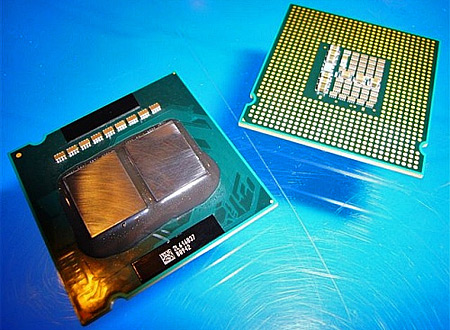
If Intel is to be believed, Kentsfield is fully compatible with the current line-up of Core 2 Duo motherboards. In certain cases a BIOS update is needed for the CPU to be recognised correctly, but it uses the same socket (LGA775) and the same 1066MHz bus. Although it consumes more energy than the dualcores, this does not exceed the maximum specifications – after all, 130Watt is needed to power the old Pentium D. Internally, Kentsfield consists of two Core 2 Duo E6700 'Conroe' chips. This design choice has been the subject of heated debates: especially AMD likes to remind us that gluing together two separate chips does not constitute a quadcore proper. It is certainly true that this choice has its downfalls: the one pair of cores can only communicate with the other via the bus, which limits the available memory bandwidth. Moreover, there is no shared cache, meaning that data can be stored twice, limiting the effectiveness of the total memory capacity of 8MB. For this reason, several benchmarks will do better on a single chip quadcore than on an MPM (multi-processor module) consisting of two dualcores.
 But not everything about this design is negative: to make a Kentsfield, it suffices to pluck a small percentage of dualcores from the production line and package them in a different way. This is a much faster process than building a separate quadcore production line. Moreover, the yields will be greater: a greater square makes the round wafer surface harder to fill, and consequently a larger portion of the disc will be lost in case of an error. Half a broken MPM quadcore can still be sold as a dualcore, but the term yield has more subtleties in practice than merely 'perfect' and 'trash'. Statistics, too, has a say in how the line-up will end up looking: In case ten percent of quadcores achieve the desired TDP, production will need to be increased tenfold compared to the perfect world scenario. By also selling versions with a lower clock value, things can be optimized, but it is less risky to aim high if there are stocks of millions of Meroms, Conroes, and Woodcrests to choose from.
According to internal research at Intel, the two dualcore approach makes for 20% higher yields and 10% less costs. The company has worked out that a single chip quadcore would cost $79,85 to make, against $71,10 for an MPM solution. Incidentally, such prices are - by far - not for the consumer: Intel will still happily asks a thousand dollars for a Core 2 Extreme QX6700. But the consumer's advantage is that Intel's quadcores will soon be available, and not in half a year's time as is the case with AMD. By the time that company ships its first quadcore, Intel expects to have sold a million of them for use in desktops and servers.
Test configuration
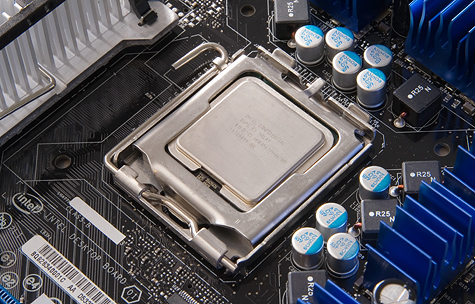
We tested the QX6700 on Intel's own 975X motherboard, the D975XBX2. In terms of features it's nothing special, but it is nevertheless a decent motherboard. The test system was equipped with 2GB of DDR2-800 memory and a Western Digital Raptor WD740ADFD. For comparison, we used previous results from our benchmark database, among which those of the Core 2 Duo, the 'old' dualcore Core 2 Extreme, the Athlon 64 (FX) and a dualcore Opteron. Unfortunately, not all systems are perfectly comparable: the AMD system turned out not be stable with 800MHz of memory. Neither Adata memory, which was used for the Kentsfield test, nor a combination of 2x 512MB Corsair XMS1066 and 2x 512MB OCZ DDR2-1000 sufficed, hence we were forced to fall back on 667MHz.
The Opteron is the same as the one we used for the database test. Since Socket F does not support DDR2-800 yet, we used 667MHz on that machine, too. A further difference is that the Opteron had a RAID5 of four Raptors instead of a single disk. Results of disk-intensive benchmarks such as Photoshop and Winstone are not tremendously comparable because of this. However, other tests, such as 7-zip, LAME, Windows Media Encoder and Cinebench are not negatively affected. Unfortunately we cannot yet show any game benchmarks in this article because not all systems were equipped with the same graphics card, but it is not to be expected that today's games can draw any profit from a quadcore processor.
With the exception of Winstone, all tests were executed using the 64bit version of Windows XP. Of Cinebench, 7-zip and the Windows Media Encoder we also used versions that can utilize the x64 extension. We used a LAME version that supports both multicore and x64. All processors were configured to use their power saving features. Even though we know that this can sometimes degrade performance a little, we believe most people will choose to have Enhanced Speedstep or Cool 'n' Quiet switched on.
Test configuration (Intel)
| Processor | Core 2 Duo | Core 2 Duo | Core 2 Extreme | Core 2 Extreme |
|---|
| Model | E6400 | E6700 | X6800 | QX6700 |
| Sockets / cores | 1 / 2 | 1 / 2 | 1 / 2 | 1 / 4 |
| Clock speed | 2.13GHz | 2.66GHz | 2.93GHz | 2.66GHz |
| Cache | 2MB | 4MB | 4MB | 2x 4MB |
| TDP | 65W | 65W | 75W | 130W |
| Memory capacity | 2GB | 2GB | 2GB | 2GB |
| Memory speed | DDR2-800
5-5-5-12 | DDR2-800
5-5-5-12 | DDR2-800
5-5-5-12 | DDR2-800
5-5-5-12 |
| Mother board | Intel D975XBX | Intel D975XBX | Intel D975XBX | Intel D975XBX |
| Chipset | Intel 975X | Intel 975X | Intel 975X | Intel 975X |
| Graphics card | ATi Radeon X1900XTX | ATi Radeon X1900XTX | ATi Radeon X1900XTX | nVidia GeForce 7950 GX2 |
| I/O controller | Intel 975X | Intel 975X | Intel 975X | Intel 975X |
| RAID-level | Single | Single | Single | Single |
| Hard disks | WD Raptor WD740ADFD | WD Raptor WD740ADFD | WD Raptor WD740ADFD | WD Raptor WD740ADFD |
Test configuration (AMD)
| Processor | Athlon 64 | Athlon 64 | Opteron |
|---|
| Model | FX-62 | X2 5000+ | 2216 |
|
| Sockets / cores | 1 / 2 | 1 / 2 | 2 / 4 |
| Clock speed | 2.8GHz | 2.6GHz | 2.4GHz |
| Cache | 2x 1MB | 2x 512KB | 2x 1MB |
| TDP | 125W | 89W | 95W |
| Memory capacity | 2GB | 2GB | 2GB |
| Memory speed | DDR2-667
5-5-5-12 | DDR2-667
5-5-5-12 | DDR2-667
5-5-5-12 |
| Mother board | Asus M2M32-Sli Deluxe | Asus M2M32-Sli Deluxe | MSI MS-9185 |
| Chipset | nVidia nForce 590SLI | nVidia nForce 590SLI | ServerWorks HT1000 |
| Graphics card | ATi Radeon X1900XTX | ATi Radeon X1900XTX | nVidia GeForce 5200 PCI |
| I/O controller | nForce 590SLI | nForce 590SLI | Areca ARC-1280 512MB |
| RAID-level | Single | Single | 4x RAID 5 |
| Hard disks | WD Raptor WD740ADFD | WD Raptor WD740ADFD | WD Raptor WD740ADFD |
Synthetic and application benchmarks
The synthetic Everest benchmark holds no surprises: since only one core is tested, the performance of the Q6700 is virtually identical to that of the E6700. which is also clocked at 2.66GHz. The 2.93GHz X6800 tends to be a few percent quicker than its successor, which serves to paint a general picture of this and other Kentsfield reviews: users that do not put the processor to work on all fours; by multitasking and/or working with multithreaded applications - are better off with a cheaper dualcore.
That ends the obvious part of this review. The real question is which applications do profit from the new quadcore. To answer that, we shall be looking at Business Winstone 2004 Multitasking, which simulates a user that uses several programmes at the same time, among which Internet Explorer, Outlook, Access, Word, Powerpoint, Excel, Norton Anti- Virus, and WinZip. As can be seen, the results aren't that far apart, so it seems as if the processor isn't the bottleneck:
 |
 | Business Winstone 2004 Multitasking Test | |
|
| Core 2 Duo E6700 |    4.4 4.4 | |
|
| Core 2 Extreme QX6700 |    4.36 4.36 | |
|
| Core 2 Extreme X6800 | 4.28 | |
|
| Athlon FX-62 |    4.25 4.25 | |
|
| Core 2 Duo E6400 | 3.97 | |
|
| Dual Opteron 2216 | 3.10 | |
|
The second test is Multimedia Content Creation Winstone 2004, which simulates a user occupied with Adobe Premiere 6.5, Adobe Photoshop 7.0.1, Newtek LightWave 7.5b, Steinberg WaveLab 4.0f, Windows Media Encoder 9, and Macromedia Director MX 9.0. The actions executed here are tasks such as encoding video fragments, rendering a multimedia stage and applying filters to images. The various applications run side by side. Even though the expectation was that the Kentsfield would be in its element with this combination of heavy multimedia and multitasking, in practise the performance is disappointing. The two extra cores make for a lousy 4% performance increase, which can just as well be achieved by going from 2.66GHz to 2.93GHz:
|
| Multimedia Content Creation Winstone 2004 | |
|
| Core 2 Extreme QX6700 | 46.6 | |
|
| Core 2 Extreme X6800 | 46.3 | |
|
| Core 2 Duo E6700 | 44.9 | |
|
| Athlon FX-62 | 41.6 | |
|
| Dual Opteron 2216 | 37.3 | |
|
| Core 2 Duo E6400 | 36.8 | |
|
To make the multitasking jobs somewhat more interesting, we reran Business Winstone, but this time with Quicktime 7.1 running in the background, which was busy encoding a movie into the H.264-format. Finally, the Kentsfield beats the competition by a fair degree:
|
| Business Winstone Multitasking Test + Quicktime (Winstone score) | |
|
| Core 2 Extreme QX6700 | 3.02 | |
|
| Core 2 Duo E6700 | 2.50 | |
|
| Dual Opteron 2216 | 2.29 | |
|
| Athlon FX-62 | 2.19 | |
|
| Core 2 Extreme X6800 | 2.13 | |
|
| Core 2 Duo E6400 | 2.07 | |
|
|
| Business Winstone Multitasking Test + Quicktime (QuickTime time) | |
|
| Core 2 Extreme QX6700 | 294.0 | |
|
| Core 2 Extreme X6800 | 407.0 | |
|
| Dual Opteron 2216 | 414.0 | |
|
| Core 2 Duo E6700 | 429.7 | |
|
| Core 2 Duo E6400 | 534.0 | |
|
| Athlon FX-62 | 535.7 | |
|
2D and 3D operations
In the 2D/3D category, we first consider Cinebench, a rendering test based on Maxxon Cinema 4D. This reveals the greatest performance gain so far: the quadcore performs 68% better than the dualcore of the same clock speed, and 53% better than the previous Extreme Edition:
|
| Cinebench R9.5 x64 | |
|
| Core 2 Extreme QX6700 | 1449 | |
|
| Dual Opteron 2216 | 1233 | |
|
| Core 2 Extreme X6800 | 945 | |
|
| Athlon FX-62 | 867 | |
|
| Core 2 Duo E6700 | 858 | |
|
| Athlon X2 5000+ | 809 | |
|
| Core 2 Duo E6400 | 688 | |
|
In the Photoshop CS2 Filtertest, various filters and transformations are performed on a set of five photographs (two with a resolution of six megapixels, and three with a ten megapixel resolution. The result of the test is the total time that Photoshop CS 2 needed for the execution of the transformations. Here, too, the quadcore proves its mettle, but not as convincingly as in the Cinebench test:
|
| Photoshop CS2 Filtertest (time) | |
|
| Core 2 Extreme QX6700 | 112.6 | |
|
| Core 2 Extreme X6800 | 133.0 | |
|
| Core 2 Duo E6700 | 139.7 | |
|
| Core 2 Duo E6400 | 171.0 | |
|
| Athlon FX-62 | 186.0 | |
|
| Dual Opteron 2216 | 195.7 | |
|
| Athlon X2 5000+ | 209.8 | |
|
The next benchmark is a combination of the Photoshop CS2 Filtertest and importing a photo shoot in the background, which consists of 199 RAW images in Adobe Lightroom (beta 3). We indicate the time needed for both applications. The dual Opteron, which was playing second fiddle in the tests so far, manages to show its teeth here by beating the Kentsfield in Photoshop. However, the Opteron's performance is probably more due to the RAID5 array than to computing power. Moreover, the AMD system spends longer on the other application, making the QX6700 the winner after all:
|
| Photoshop + Lightroom (Photoshop time) | |
|
| Dual Opteron 2216 | 207.2 | |
|
| Core 2 Extreme QX6700 | 235.5 | |
|
| Core 2 Extreme X6800 | 267.6 | |
|
| Athlon FX-62 | 285.6 | |
|
| Core 2 Duo E6700 | 290.5 | |
|
| Athlon X2 5000+ | 300.2 | |
|
| Core 2 Duo E6400 | 341.8 | |
|
|
| Photoshop + Lightroom (Lightroom time) | |
|
| Core 2 Extreme QX6700 | 664.6 | |
|
| Core 2 Extreme X6800 | 779.9 | |
|
| Core 2 Duo E6700 | 867.6 | |
|
| Core 2 Duo E6400 | 927.6 | |
|
| Dual Opteron 2216 | 991.8 | |
|
| Athlon FX-62 | 1065.8 | |
|
| Athlon X2 5000+ | 1111.9 | |
|
We ran the Photoshop CS2 Filtertest for a third time with another application running in the background. This time, 102 JPEG images are de-noised using Neat Image 5.5, and subsequently saved as .tiff files. Again, we show what time both applications needed. The quadcore does a very good job by beating its dualcore predecessor by three minutes, which means a cut in the time needed of 37%:
|
| Photoshop + Neat Image (Photoshop time) | |
|
| Core 2 Extreme QX6700 | 133.7 | |
|
| Core 2 Extreme X6800 | 173.5 | |
|
| Core 2 Duo E6700 | 184.1 | |
|
| Athlon FX-62 | 223.6 | |
|
| Dual Opteron 2216 | 244.7 | |
|
| Core 2 Duo E6400 | 278.4 | |
|
| Athlon X2 5000+ | 318.9 | |
|
|
| Photoshop + Neat Image (Neat Image time) | |
|
| Core 2 Extreme QX6700 | 310.2 | |
|
| Core 2 Extreme X6800 | 448.0 | |
|
| Core 2 Duo E6700 | 494.7 | |
|
| Dual Opteron 2216 | 581.1 | |
|
| Core 2 Duo E6400 | 618.8 | |
|
| Athlon FX-62 | 734.7 | |
|
| Athlon X2 5000+ | 779.9 | |
|
Encoding and compression
Conclusion
Without a doubt, Kentsfield is quite a monster. Although according to some, it is not a 'real' quadcore, this is barely noticeable, at least not without physically opening it and taking a peek inside. The performance leaves little doubt that two extra cores can make for significant gains. It is important, however, that potential customers think hard before ordering one, because not all software brings out the chip's power. The scenarios with several heavy applications crunching away aren't daily business for many people. A dual core of the same clock speed can be purchased for almost half the money and moreover, these are significantly more energy efficient, so there is a large gap between the two that is not really reflected in the difference in price. For people who often work with 3D models or photo and/or video software, the Core 2 Extreme QX6700 may be just what they need – but for ordinary users and even for gamers, it's probably not worth it. Naturally, the quadcore is prepared for the future, but in many cases the money is simply better spent on other things.
Intel, for its part, does not expect a great rush on the new CPU's, which is probably the right position to take given the price tag. The Core 2 Quad Q6600 (2.4GHz, $851) that is expected in January, will make quadcores somewhat more accessible for ordinary mortals, but the company still does not expect Kentsfield to take more than a few percent of the desktop market. The quadcore Xeon DP 'Clovertown' and Xeon MP 'Tigerton' will probably become much more popular in their respective market segments. But, by the time the chip, with its price tag of $999, hits the shops, at least Intel can call itself 'the first'.
Although we wrote earlier that AMD will be shipping its quadcore in six months time, it isn't the case that they have absolutely nothing to show at the moment. The company will be releasing its dual socket QuadFather systems, which are aimed at the gaming market. These will consist of sets of two Athlon FX-70 (2.6GHz), FX-72 (2.8GHz) and FX-74 (3.0GHz). Rumour has it that a duo of 2.6GHz chips, which is also a four core system, will cost the same as a Core 2 Extreme QX6700. It will be interesting to compare the performance of these two platforms.

:fill(white):strip_exif()/i/2000831678.jpeg?f=thumbmedium)
:fill(white):strip_exif()/i/2000831690.jpeg?f=thumbmedium)
:fill(white):strip_exif()/i/1195226475.jpg?f=thumbmedium)

:strip_icc():strip_exif()/u/80211/crop625154a54bd09_cropped.jpg?f=community)
:fill(white):strip_exif()/i/2000831744.jpeg?f=thumbmedium)