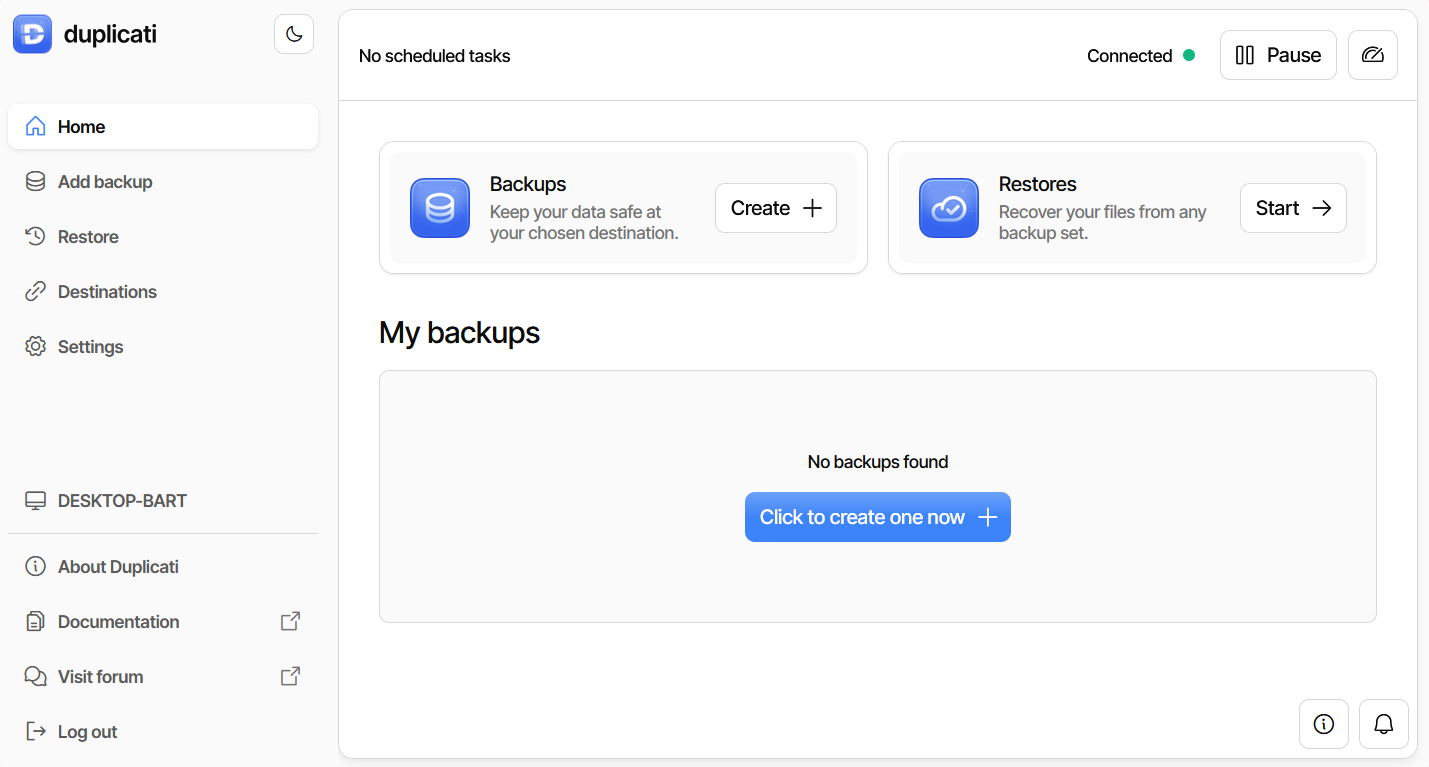
 Duplicati is opensource back-upsoftware waarmee je bestanden automatisch kunt opslaan naar onder meer een lokale schijf, nas of cloudopslag. Het ondersteunt versleuteling, compressie, versiebeheer en incrementele back-ups. Het kan ook eerdere versies van bestanden mee terugzetten als iets per ongeluk is verwijderd of beschadigd. Met een gratis account kunnen back-ups van maximaal vijf apparaten worden gemaakt, en er zijn ook betaalde abonnementen voor bedrijven. Versie 2.3.0.0 is uitgekomen en hier zijn de volgende veranderingen en verbeteringen in aangebracht:
About this releaseThis is the next stable release for Duplicati 2.3, building on the 2.2 release with new features and bug fixes. A big thanks to the supportive Duplicati user base who continues to contribute with fixes, issue reports and feature requests. If you have already been using the beta release, this release is the same as v2.2.1.0, but includes a bugfix and two library updates.
Database Schema UpdateNote: This update changes the Server database schema to version 11. The database tool can perform downgrades if needed.
Multiple Backup DestinationsThis version adds support for configuring multiple destinations for a single backup job. This allows you to backup to multiple locations simultaneously, such as a local drive and a cloud storage provider. With multiple destinations, you can now configure a complete 3-2-1 backup strategy in a single job. After each completed backup, Duplicati will ensure that data is available on all destinations. A 3-2-1 backup strategy is where you have 3 copies of your data, 2 of which are on different media, and 1 of which is offsite/immutable.
Remote SourcesRemote sources are now easier to use with UI support and a prominent button on the source page. This version also adds support for using Box, Dropbox, OneDrive, and Google Drive as remote sources.
Windows Folder Status IndicatorThis version adds a Windows shell extension that shows the backup status of folders with icon overlays. The feature is disabled by default but can be enabled with the option
Google Workspace Backup--enable-folder-status-serviceon either Server or TrayIcon. Once enabled, run theRegisterFolderStatusExtension.ps1script to register the extension and see backup status in Windows Explorer.This version adds support for backing up Google Workspace, including Gmail, Google Drive, Contacts, Calendar, and Chat. This is a proprietary module (source available) that requires a license to use in production. Without a license, testing is possible with up to 5 users. To prevent proprietary modules from loading, set the environment variable
Office 365 BackupDUPLICATI_DISABLE_PROPRIETARY_MODULES=1or delete files namedDuplicati.Proprietary.*from your installation.This version adds support for backing up Office 365 tenants, including mailboxes, calendars, contacts, OneDrive, Planner, Tasks, Teams, Sites, and more. This is a proprietary module (source available) that requires a license to use in production. Without a license, testing is possible with up to 5 users + 5 sites + 5 groups.
Full Disk BackupThis version adds simple support for backup and restore of entire disks, including the MBR/GPT partition table. In this initial version, only Windows is supported, and the backup accesses the disk directly (no VSS). Support for Linux and macOS, as well as VSS support for Windows, is planned for future releases. Like the Office 365 / Google Workspace features, this is a proprietary module (source available). Full disk backup requires administrative privileges to access the disk directly. Full disk restore requires administrative privileges and requires that the disk is unmounted and not write-protected.
Remote File LockingThis release adds support for remote locking of files on supported storage providers (S3, Azure Blob Storage, Backblaze B2, iDrive e2, Google Cloud Storage). Locking protects backup files from being deleted or overwritten during a configurable retention period. To use the feature, set the advanced option
Templating Engine for Reporting--remote-file-lock-duration(e.g.,30Dfor 30 days). Each backend supportsgovernance(lock can be removed in admin console) orcompliance(lock cannot be removed) modes.It is now possible to use a Handlebars template to format the report output, which is especially useful for crafting custom email reports.
Synology Native PackageThe Synology native package has been re-developed to support Synology DSM 7.2 and above. The package installs as any other Synology package and uses integrated DSM authentication.
Soft Delete SupportA new option
Platform Updates--soft-delete-prefixenables the soft-delete feature. When enabled, files are renamed/moved instead of being deleted, allowing lifecycle management rules to handle actual deletion after a retention period.Database Encryption Changes
- .NET 10: The application now runs on .NET 10 for improved performance
- SQLite: Updated to use
Microsoft.Data.Sqlitefor better performance and async query support- VSS Provider: Default VSS provider on Windows is now Vanara (AlphaVSS is no longer maintained)
This release adds a "default secret provider" for the current OS:
- Windows: Windows Credential Manager
- macOS: Keychain
- Linux: libSecret (Gnome Keyring), or commandline
passif availableIf no secret provider is configured, and a default secret provider is available, the database will be encrypted with a random password stored in the default secret provider. To opt-out, use
Simplified S3 Provider Configuration--disable-db-encryptionwhen starting the Server/TrayIcon. If database encryption is already configured, or no default secret provider is available, nothing will change.The S3 provider configuration has been simplified by providing fewer options and only showing relevant endpoints. A whitelist of public S3 providers is included, and hostnames are shown in backup reports if in the whitelist.
New LanguagesAdded support for Hungarian, Czech, and Polish languages. Thanks to all translators!
Quality of Life ImprovementsNotable Bugfixes
- The commandline-inside-the-UI feature now saves its state when navigating back
- Added "Edit as text" option for source paths and filters
- Linux AppImage builds are now available
- Auto VSS on Windows when user has Administrator privileges (
SeBackupPrivilege)- SSH-Agent support for SSH backend
- Support for macOS Photos backup with
--photos-handlingoption- New UI is more small-screen friendly
- Fixed issue with invariant formatting causing crashes during backup
- Fixed dry-run to strictly not touch data
- Fixed
--changed-filesoption to not introduce extra dangling file entries- Fixed purge operation size calculation and added
--reduced-purge-statisticsoption- Fixed index file corruption issue where index files could become incomplete over time
- Fixed restore flow to reduce temporary space usage (configurable with
--restore-volume-cache-hint)

:strip_exif()/i/2008120088.png?f=thumbmedium)
/u/263454/crop69528a83920d8.png?f=community)

:strip_exif()/u/230134/crop6a2d6bda64f25_cropped.gif?f=community)
:strip_icc():strip_exif()/u/148932/crop654a13278f8cb_cropped.jpg?f=community)