Intro
 Tweakers log, stardate 00200700, time 0255: Na berichten dat de multiplier van de Duron en Thunderbird toch door AMD gelockt zou worden, voltrok zich een race tegen de klok. Over de hele wereld gingen overklokkers en andere fanaten aan de slag om zo snel mogelijk een oplossing te vinden waarmee de multiplier lock verbroken kan worden.
Tweakers.net kon natuurlijk niet achterblijven. In no-time werd er een moederbord geregeld en een processor gekocht. Dinsdagmiddag om 14:00 uur zaten Jasper, Floris en ikzelf klaar met de soldeerbout, draden, jumpers en tin, met voor ons een GigaByte GA-7ZM en een Duron 600.
Op de volgende pagina's wordt verslag gedaan van onze avonturen. Hoewel het soms best wazige techniek is hebben we geprobeerd het voor iedereen begrijpelijk te houden. Onder grote tijdsdruk (het is nu inmiddels bijna drie uur 's nachts) hebben wij in zeer weinig tijd dit artikel geschreven, het kan zijn dat je hier of daar nog wat oneffenheden vindt. Van te voren vast onze excuses daarvoor. Voor verdere vragen kun je natuurlijk terecht op het Forum.
Wat info vooraf
De multiplier van de Duron wordt bepaald aan de hand van twee factoren, namelijk FID en BP_FID (FID = Frequency ID). Het signaal hiervan wordt doorgestuurd naar de northbridge op het moederbord. De northbridge stuurt vervolgens weer een signaal terug. Afhankelijk van dit signaal bepaald de processor op welke multiplier hij moet draaien. De kunst is om het signaal dat de processor stuurt zodanig te wijzigen dat de multiplier verandert.
Omdat BP_FID niet gedocumenteerd is in de AMD-datasheets was het lastig om de oplossing voor bovenstaand probleem te vinden. Met wat hulp van een wazige japanner en een nog waziger Xoom site was er echter vrij vlot een plan van aanpak gereed.
De multiplier van de Duron wordt gelockt door 4 gouden bruggen (aangeduid met L1) met een laser door te branden. Dit verbreekt de verbinding met de BP_FID pinnen, waardoor het signaal niet veranderd kan worden. Alle retail Durons zijn op deze manier gelockt, zo ook de onze. Op het onderstaande plaatje is een niet-gelockt Duron afgebeeld. Dit is duidelijk te zien aan de L1 bruggen die keurig intact zijn:
Verder bestaan er nog verschillen tussen moederborden. Een aantal mobo's, waaronder de Asus A7V, bieden de mogelijkheid om de multiplier te wijzigen. Het door ons gebruikte Gigabyte GA-7ZM kent deze mogelikheid niet.
Samengevat zijn er 4 mogelijkheden:
 Duron niet gelockt + moederbord met multiplier tweaking on-board
Duron niet gelockt + moederbord zonder multiplier tweaking
Duron gelockt + moederbord met multiplier tweaking
Duron gelockt + moederbord zonder multiplier tweaking.
De eenvoudigste situatie is de eerste combinatie (duh!). In dat geval is het een kwestie van dipswitches omzetten en je bent klaar. Bij de derde optie moet je 'alleen' de Duron te bewerken, iets wat vrij eenvoudig blijkt te zijn. Wanneer nu je nu al een de beschikking hebt over een Socket A bord zonder multiplier tweaking, heb je wat meer werk te verzetten. Je zult de mogelijkheid om de multipliers te kunnen veranderen dan zelf in elkaar moeten knutselen.
Onze taak was de zwaarste: we moesten de Duron zien te unlocken en vervolgens trachten het moederbord zodanig te modificeren dat we de multiplier ook daadwerkelijk konden aansturen. Hoe we dat precies gedaan hebben wordt op de volgende pagina's uitgelegd.
FID veranderen
Het verhaal van de FID is simpel. FID bestaat uit een getal van 4 bits. Voor iedere bit gaat normaal gesproken het signaal van de CPU naar de northbridge. De northbridge legt het signaal via een weerstandje aan Vio. Als er dus verder niets gebeurt is het signaal hoog. Via het moederbord, de socket, een pin aan de Duron, en de Duron zelf, komt dat signaal vervolgens bij een van de uiteinden van de gouden bruggen op de Duron. Aan de overkant van die bruggen zitten bruggehoofden die in de processor verbonden zijn met 0V.
Voor ieder bitje geldt dat als de bijbehorende gouden brug open is, het bitje positief (1) is. Bij een gesloten brug heeft de bit een waarde van 0. Wat wij willen is dat niet de processor deze bitjes bepaald, maar wij zelf. De oplossing is heel simpel: we solderen de bijbehorende pin uit de socket, waardoor de bruggen buitenspel worden gezet. Vervolgens solderen we een draadje naar een setje jumpers of dipswitches, die de functie van de gouden bruggetjes overnemen.
Dit hebben we vervolgens ook maar gedaan, zie het schemaatje. Je ziet links het elektrische schema voor behandeling, en rechts de situatie nadat onze soldeerbout aan het werk geweest is  .
.
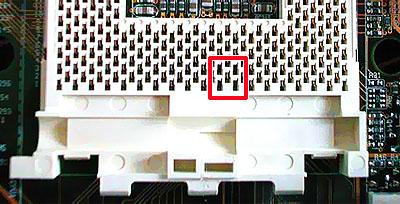
De eerste stap is de pinnen van de processor losmaken van het moederbord. De eenvoudigste manier daarvoor is het simpelweg verwijderen van de bijbehorende connectors in het socket. Het kost enige moeite om het socket uit elkaar te krijgen, maar met wat handigheid en doorzettingsvermogen is het best te doen. Vervolgens soldeer je de 4 connectors los door met een soldeerbout de tin op het moederbord los te maken. Vervolgens kun je de connectors er zo uittrekken. Het is overigens verstandig dit eerst te oefenen op een oud moederbord of een goedkope slocket. Het uiteindelijke resultaat ziet er als volgt uit:
Stap twee is het maken van een verbinding tussen de jumpers en de aansluitingen onder het moederbord die corresponderen met de connectors die je net hebt weggehaald. Wanneer je een beetje handig bent met de soldeerbout is dit allemaal vrij eenvoudig te doen:
BP_FID veranderen
BP_FID is (inmiddels) eigenlijk makkelijker, als je processor maar niet gelocked is. BP_FID bestaat net als FID uit vier bitjes, waarbij FID en BP_FID hetzelfde moeten staan anders weigert de processor dienst. Dus moeten we ook BP_FID veranderen om de multiplier te kunnen veranderen.
Ieder van de BP_FID signaallijnen hangt via de gouden bruggetjes op de proc en een weerstandje aan ongeveer 2.0V of aan 0V. Bovendien hangen ze via een tweede gouden bruggetje aan pennetjes op de processor die AMD heel sneaky in de datasheet als "Not Connected" aangeeft. Dat signaal gaat vervolgens naar de processor, en die gebruikt het om te controleren of hij het signaal wat hem via de FID gevoerd wordt wil accepteren.
Wat je dus doet om die gouden bruggen van de processor te negeren, is heel simpel: je maakt een jumperblokje, met draadjes in het midden die naar de "Not Connected" pinnen gaan, en aan weerskanten zet je 0V en ~ 2V. Met die jumpertjes "overschreeuw" je als het ware de instelling van de processor.
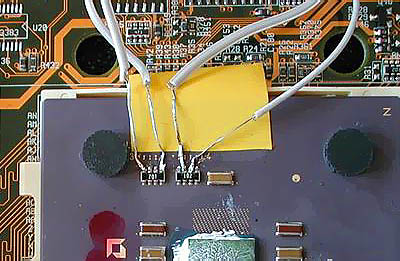
Op dit moment namen wij aan dat de interne verbinding tussen de BP_FID pinnen op de processor en de L3 en L4 bruggen niet meer bestond. De enige oplossing was aldus het leggen van die verbinding buiten de processor om, door een 4-tal draden aan de weerstanden (de twee rechthoekige blokjes) te solderen.
En nu komt de grote truc: de verbinding tussen L3, L4 en de BP_FID pinnen is nog wel degelijk aanwezig, alleen loopt die via de L1 bruggen! En omdat AMD deze verbinding weg heeft gehaald staan de BP_FID pinnen in de datasheets als 'not connected'. Door de L1 bruggen te sluiten kun je weer controle krijgen over BP-FID via het moederbord, en daar gaat het ons om.
Met een moederbord dat deze functie al on-board heeft ben je dan klaar. Als je dat niet hebt moet je het alsnog zelf maken, op ongeveer dezelfde manier als bij FID, met als voordeel dat je geen connectors uit het socket hoeft te halen. Daarover later meer.
Moederbordmodificaties in het kort
Ik hou dit stukje met opzet redelijk technisch. Als je dit niet begrijpt kun je waarschijnlijk beter iemand met iets meer soldeerervaring vragen om dit voor je te doen. Wat moet je nu dus feitelijk doen, zonder alle theorie eromheen?
Als je het volgende dingetje op een stukje gaatjesbord opbouwt, hoef je verder alleen nog maar wat draadjes aan te sluiten. De eerste vier jumpers zijn voor BP_FID, de tweede set van vier voor FID, en de derde set is voor VID, maar die kun je waarschijnlijk overslaan omdat de meeste moederborden al voltage-tweaking mogelijkheden hebben.
Nadat je dit gebouwt hebt sluit je een trits kleine draadjes aan op die middelste/bovenste rij contacten. Dan wordt het moeilijk: je moet de socket demonteren, zodat de kap eraf wipt, en dan kun je de volgende pinnen lossolderen uit het moederbord: W1, W3, Y1, en Y3. Als je ook voltagetweaking wilt installeren, soldeer dan ook de pennen L1, L3, L5, L7, en J7 los.
De draadjes die vanaf je jumperplankje komen sluit je, van links naar rechts, aan op de volgende punten onder de socket op het moederbord: AL25, AN25, AL27, AN27, dan Y3, Y1, W3, W1, en als je voltagetweaking wilt installeren ook nog J7, L7, L5, L3, en L1. Daarna nog even de 0V en 3.3V aansluitingen van de jumperplank op de voeding aansluiten, en je bent klaar.
De tabel met settings voor zowel BP_FID als FID is de volgende:
Al deze avonturen resulteren in de volgende situatie:
1 = BP_FID. Na het doorverbinden van L1 verdwijnt deze kabel onder het moederbord
2 = FID. Deze kabel zit vast aan 4 pinnen onder het socket
3 = VID: voltage aanpassingen. Ook dit gaat via de onderkant van het socket
4 = de voeding van het jumperplankje. Hiervoor wordt 3,3 volt afgetapt van de ATX-voeding.
Gelockte processor weer ontsluiten
Maar wat nu als je net als ons een gelockte processor in handen krijgt waarbij de BP_FID pinnen naar de socket zijn afgesloten?
De vage gast van deze wazige Xoom site is erachter gekomen dat het verbreken van de gouden bruggetjes bij L1 op een niet-afgesloten processor precies dat effect heeft. Wij keken dus naar onze processor en inderdaad, de bruggetjes bij L1 zijn doorgebrand terwijl alle processors waarvan we tot nu toe foto's hebben gezien de L1 bruggen gesloten hebben. Niet getreurd, die bruggen kunnen we weer sluiten!
Bij de lokale handel in ijzerwaren is het me met wat moeite (en vette korting  ) gelukt om een reeds aangebroken flesje 'Bison Electro Kit' te bemachtigen. Dit is een soort van niet al te stevig plakkende lijm met allemaal zilverdeeltjes erin, waardoor het elektriciteit geleid. Het spul wordt verkocht om bijvoorbeeld autoruitverwarmingen en videorecorders te repareren.
Met behulp van dit potje (ongeveer 30 gulden voor 3 milliliter, maar je kunt er waarschijnlijk tientallen processors mee behandelen) en een speldepunt werd wat van dit goedje op de L1 bruggen aangebracht. Nu heeft de processor weer BP_FID pinnetjes, waardoor je de multiplier op ieder moederbord met onboard multiplier tweaking kunt veranderen. Het door ons gebruikte Gigabyte mainboard heeft na onze soldeerpartij ook onboard multiplier tweaking waardoor we met hartelust de multiplier van de Duron kunnen veranderen.
De kwaliteit van deze foto is sterk verbeterd. Met behulp van een Fuji 50mm 1:2 P-draad lens als loep voor de lens van de camera is het eindelijk gelukt een fatsoenlijke foto te maken.
Na de moederbord operatie ziet de onderkant van het bord er als volgt uit. BP_FID werd vastgemaakt aan de pinnen die via L1 naar L3 en L4 gaan:
Voorlopige conclusie
Als de lock die AMD voor ogen had bestond uit het doorbranden van L1, dan is er toch nog goed nieuws voor de tweaker. Het blijkt zeer eenvoudig en goedkoop te zijn om deze verbinding te herstellen en dus de lock van de processor op te heffen.
Nogmaals: het enige wat je moet doen om de multiplier lock op te heffen is de L1 bruggen weer verbinden met een geleidende kit of lak. Zijn die bruggen al verbonden dan is je Duron dus sowieso niet gelockt!
Met een moederbord dat al voorzien is van jumpers of dipswitches om de multiplier aan te sturen wordt het overklokken dan wel heel makkelijk. Heeft je moederbord dat niet, dan is er nog geen man/vrouw overboord. Je kunt het namelijk ook heel goed zelf maken, zoals in het verslag te lezen is. Het vergt dan wel wat meer tijd, moeite, een vaste hand en vooral lef, maar het is te doen!
Onze 600 MHz Duron is volledig stabiel op 900 MHz, een winst van 50%! Daarboven wordt de warmte een groot probleem. Op 950 MHz is het systeem wankel, op 1 GHz domweg onbruikbaar. Na een half uur idlen loopt het systeem onherroepelijk vast. Wij gaan in ieder geval de komende tijd proberen de Duron met behulp van waterkoeling stabiel op 1 GHz te krijgen.
Zelfs al mocht AMD besluiten ook de interne verbinding van BP_FID weg te halen (hoe ze dat zouden moeten doen zonder de hele processor opnieuw op te bouwen is mij een raadsel, maar goed ) dan is er nog om heen te werken. In dat geval zul je net zoals wij in eerste instantie de verbinding "buitenom" moeten leggen.
Slot
De laatste dagen zijn voor ons drieën (Jasper, Floris en Daniël) nogal koortsachtig geweest. We hebben alles op alles gezet om als één van de eerste sites ter wereld (zo niet de eerste) met een review te komen van een volledig gelockte Duron die toch over te klokken is, en nog vrij eenvoudig ook. De komende dagen zullen we besteden aan het verder finetunen van de Duron en de review, dus dit verhaal is nog lang niet over.
Houdt sowieso de .plan tracker in de gaten, daar zullen nieuwe ontwikkelingen aangekondigd worden.
Rest mij nog Paul Hubert te bedanken, die bereid was één van zijn moederborden op te offeren aan onze soldeeravonturen .
For our English speaking visitors
This is a short summary of the Dutch story, the full story can be found here.
In fact there is only one important fact that we discovered: We can confirm AMD has locked the multiplier by cutting the L1 bridges. Durons where these bridges are still connected (like at Anandtech) are not locked, even though they are normal retail parts.
The L1 bridges are connected to the BP_FID pins, and that's why AMD lists those pins as not connected: they have removed that connection themselves by cutting the L1 bridges.
So all you'll have to do to break the multiplier lock is to reconnect the L1 bridges with some kind of conductive fluid and get yourself a motherboard capable of multiplier changing (like the Asus A7V)
Our Duron was stable all the way up to 900 MHz (not bad for a 600 MHz part, I guess), and a bit shaky at 950 (all at 1,85 V-core) The magical 1 GHz barrier could be reached, but not stable with air-cooling. We are trying to get it stable at 1 GHz with the help of water cooling. At 950 MHz and above, heat becomes a big issue for the Duron. If you want to shoot for 900+ speeds, we strongly advise to invest some serious money in sufficient cooling.
If you already have a SocketA motherboard and it has no multiplier-tweaking capabilities, there is still nothing lost, as you can build that yourself. The voltage-changing is also not a very big issue, as that is normally a function already present on the motherboard. But then again, you could still build that yourself. All that's needed is some soldering expierience, a little luck and a lot of courage
We expect guides about that to pop up all over the internet very soon for every available SocketA board.






 ) maar moet ik ook de volts aanpassen en zo ja op hoeveel moet hij dan staan ( kunnen jullie ff een klein schematje maken voor de verschillende snelheden/volts..?? thx 4 all......
:strip_exif()/u/13938/head.gif?f=community)
:strip_icc():strip_exif()/u/4738/crop61e94d5cc0eac.jpg?f=community)
 )
):strip_icc():strip_exif()/u/484/crop651fd77412597_cropped.jpg?f=community)
 .
. .
./u/8038/crop65b285059c6d6_cropped.png?f=community)
 Is ie toch stiekum locked?
:strip_icc():strip_exif()/u/9434/b17_2.jpg?f=community)

 Het is gelukt....